AthleticMindUniversity partnershipsDiscuss your pilot

For university athletics

A stronger mind.
A supported
athlete.

Mental performance training and a connected path to your university’s care team. Together in AthleticMind.

Built around athletes. Put into practice with your people.

Basketball athlete preparing to move on an indoor court
MENTAL PERFORMANCE.
MENTAL CARE.

01 / One connected experience

See it from
every side.

Athletes build a routine. Coaches help it fit the week. Your clinical team owns care and follow-through.

The athlete’s day

Practice for the
pressure of sport.

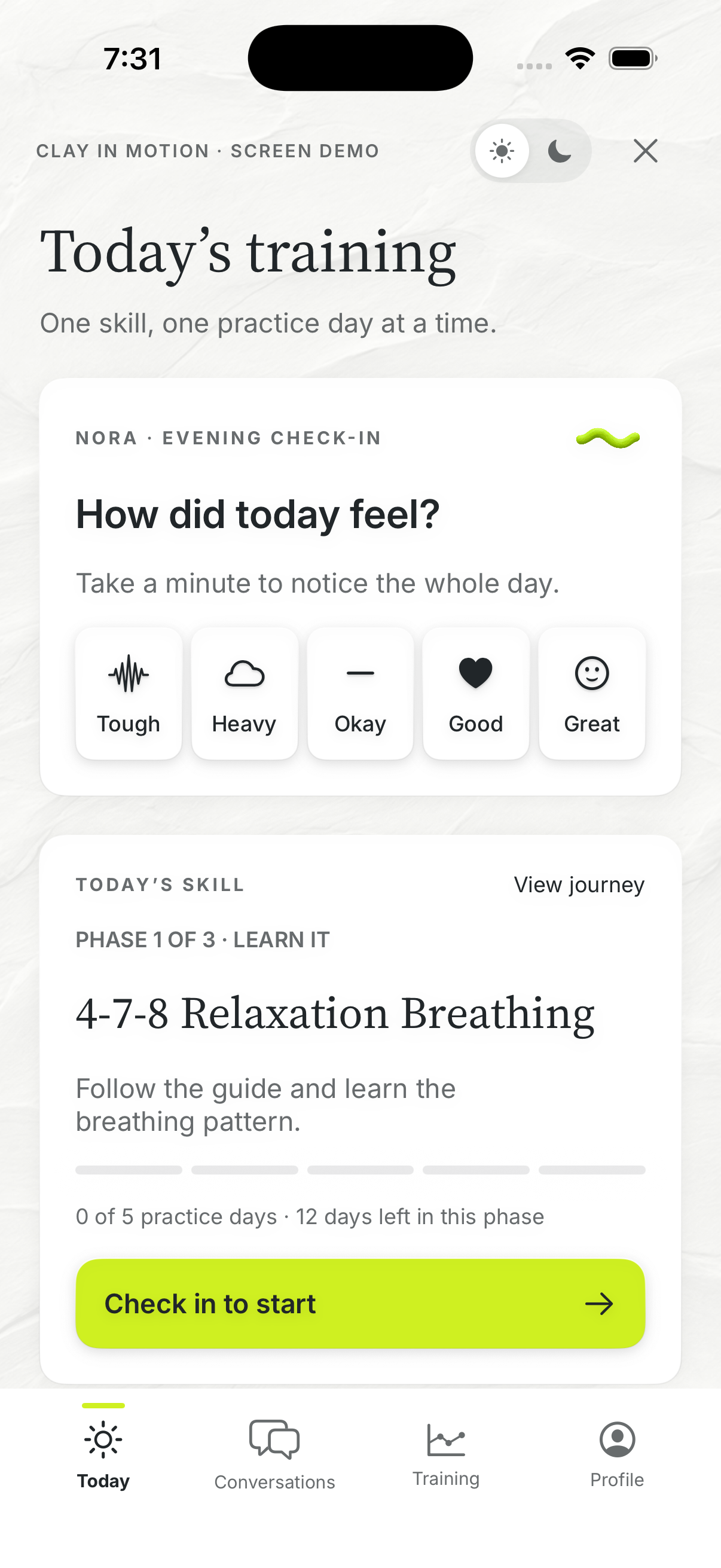
A place to check in, learn a mental skill, and take a useful cue into the next practice or game.

  1. Notice how the day felt.Make a short check-in part of the routine.
  2. Practice a skill.Follow structured training and assigned practice.
  3. Know where to turn.Find a path to the university’s designated support team.
Try the check-in experience ↗
Athlete product preview showing an evening check-in and 4-7-8 relaxation breathing practice
A small routine.
A skill to take into sport.
Product preview. Your demonstration will confirm the functions available for your pilot.

02 / Built around your people

A shared plan.
Clear responsibilities.

Start with the staff and services you already have. Define ownership together before athletes join.

AthleticMind provides

The platform.
The implementation support.

  • Mental performance skills training and education
  • Clinical connection and care-management tools
  • An implementation lead and product support contact
  • Agreed onboarding, staff training, and reporting
Your university provides

The people.
The care pathway.

  • An executive sponsor and athletics coordinator
  • Clinical staffing and a designated clinical lead
  • Clinical assessment, treatment, and emergency procedures
  • Technical, privacy, and purchasing review
Agreed together

Cohort and dates · Staff workload · Access and consent · Support hours · Success measures · Scope and price

The proposed model includes university-provided care. Clinical labor and therapy sessions are outside the platform offer.

03 / Start focused

One cohort.
A useful decision.

Give your team a practical way to assess fit before deciding on a wider rollout.

Up to 50athletes
12weeks

The standard pilot is $7,500. Different cohort sizes, timelines, or services can be scoped around your university’s needs. Explore standard and custom pricing ↗

  1. Before launch

    Agree the plan.

    Name owners, map the care pathway, agree measures, and put the decision date on the calendar.

  2. Week one

    Build the routine.

    Support onboarding, train staff, and resolve early friction for athletes.

  3. During the pilot

    Learn together.

    Review a weekly scorecard. Meet with the coordinator and coach every two weeks.

  4. Midpoint + close

    Make the decision.

    Review evidence with the sponsor. Agree continuation, expansion, a bounded extension, or closeout.

Care concerns follow your university’s response process throughout the pilot.

Download the pilot blueprint ↓

04 / Evidence you can use

Know what you’re
learning.

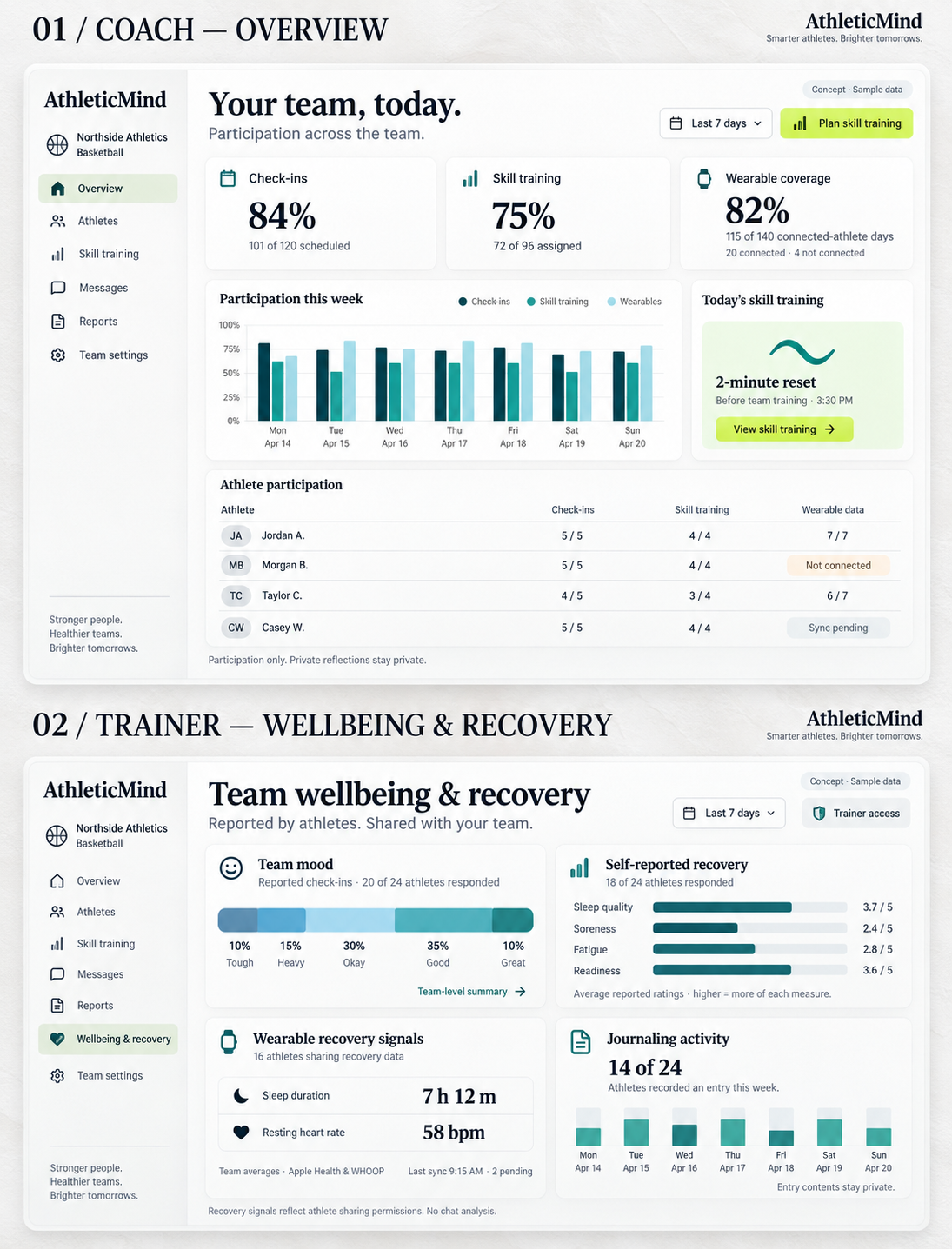
Agree the measures before launch. Review participation, reported usefulness, and how the support pathway works.

01

Will athletes use it?

Starting Point completion, weekly check-ins, assigned practice, and paired participation.

02

Is it useful?

Athlete trust, athlete and coach feedback, Coach Check-Ins, and interest in continuing.

03

Does the pathway work?

Concerns reviewed, confirmed care connections when needed, and descriptive team wellbeing trends.

YOUR PILOT SCORECARDPlanning preview

A clear readout.
With the context attached.

Weekly participation
Not yet collected
Athlete-reported usefulness
Not yet collected
Coach Check-Ins
Not yet collected
Confirmed care connections
Not yet collected

Each result includes its period, eligible population, response coverage, and missing data.

Explore the 12-measure example ↗The linked example uses illustrative numbers and quotes, not customer results.

Participation and feedback describe use and perceived value. Wellbeing trends are descriptive; they do not establish clinical improvement or program impact. Collection readiness and reporting thresholds are agreed before launch.

05 / Bring your team along

The next conversation
starts here.

Share the overview with your sponsor. Bring the pilot blueprint to the people who will put it into practice.

A few practical questions

Before you
get started.

How does this fit with our existing care team?

Discovery maps your current referral and follow-through process. Together, we confirm the designated clinical team, staff capacity, configuration needs, and any integration work before agreeing the pilot scope.

Who can see athlete information?

Coaches review participation. Authorized clinical staff manage clinical information. Private journal entries and Nora conversations stay out of coach dashboards. Your university reviews the specific access configuration, consent, data flows, retention, and reporting thresholds before launch.

Does the offer include clinicians or round-the-clock monitoring?

Your university supplies clinicians and owns emergency response. The pilot agreement sets monitoring hours, response expectations, and the responsible staff.

What does a pilot cost?

The standard 12-week pilot is $7,500 for up to 50 athletes. Full-suite annual university partnerships start at $50,000, with standard pricing of $150,000 for 500 athletes. Custom builds, integrations, and expanded services are quoted in a separate scope of work. See university pricing ↗

How do Nora, support signals, and human care work together?

Mental performance with Nora. Nora is AthleticMind’s AI mental-performance coach. Athletes can talk through a difficult practice, prepare for pressure, and work on focus or confidence with a practical next step.

A path to human support. AI-assisted review can surface support concerns in athlete input permitted by the program’s consent and access rules. These signals invite human review; they are not diagnoses and cannot identify every concern. Where enabled, routine clinical handoffs require the athlete’s recorded consent and a configured pathway to designated human staff. Your university’s clinicians own assessment, treatment, and follow-through. Urgent safety situations follow the university’s emergency procedures.

Developed capabilities, ongoing validation. Nora coaching, support-signal review, and handoff tools have been developed. Your demonstration confirms which functions are available for your pilot. Signal quality, handoff reliability, and athlete outcomes remain subjects for validation; predictive accuracy and clinical effectiveness have not been established.

What happens at the end of the pilot?

Your sponsor reviews the evidence against the criteria agreed at kickoff. Together, you decide on paid continuation, measured expansion, a bounded extension, or closeout, with clear ownership of the next steps.

Start with your university

Let’s find the right
first step.

A 15-minute conversation to discuss your athletes,
the people supporting them, and the timing that works.

Discuss your pilot Or email Tremaine at tre@fitwithpulse.ai

University partnerships

Let’s discuss your pilot.

Tell us how to reach you. We’ll follow up to arrange a conversation about your university’s needs.